
About Us

Our Mission Statement

To reduce poverty and assist in the renewal of primarily inner city communities by providing capacity building services that assist low-income individuals, groups, organizations and economically distressed neighborhoods to improve their social and economic vitality.

Our History

SEED Winnipeg was formed in the late 1980s as a result of a major study into the economic development needs of Winnipeg’s inner city. After a number of years of searching for resources, SEED Winnipeg opened its doors in January 1993 with two staff on Ellice Avenue in the West End.

SEED eventually grew into two offices with twenty staff, one on Logan Avenue in the Exchange District, and one on Selkirk Avenue in the North End.

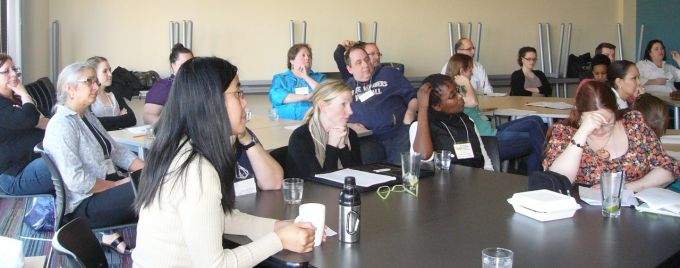
SEED staff and board, 2010/2011.

In April 2006, SEED rejoined its forces into our current offices at 80 Salter Street in the North End. SEED is the proud owner of this beautifully renovated building which will enable SEED to continue to grow and develop both its staff and its programs.

SEED has a solid, diverse funding base that enables long-range planning and offers continuity in program delivery. The ability to operate programs over an extended time frame also makes it possible to assess program impacts over longer periods of time.

Our Strategic Plan for 2009-2012

To increase the economic participation and self-reliance of Aboriginal community members.

  • Increase availability of economic development programs to the Aboriginal community.
  • To strengthen our capacity to serve the Aboriginal community across all SEED programs
  • To foster relationships between SEED and the Aboriginal community and increase SEED’s capacity to learn from the community.
  • To increase the Aboriginal participation through staff and board
  • To increase internal understanding of Aboriginal programs and Aboriginal issues.
  • To increase knowledge about and use of co-op as a primary strategy for economic development in the Aboriginal community.
  • Increase capacity to deliver co-op training and consulting for Aboriginal community members and projects.
  • Work with AssetBuilders Partnership members to increase the participation and retention rate of Aboriginal community members in their Asset Building Programs.

To encourage and support the provision of accessible, equitable and appropriate asset building opportunities including matched savings programs, money management training and access to RESP’s in under-served communities.

  • Develop and deliver an enhanced housing IDA and stand alone MMT program.
  • Improve the delivery of ABP through revisions of the MMT, the addition of asset-specific workshops and the development and implementation of enhanced case management processes.
  • Increase the uptake of the Canada Learning Bond and the Canada Education Savings Grant among low-income parents in Manitoba through enhanced service provision and by working in collaboration with financial institutions and other organization to address structural barriers.
  • Maintain and enhance the delivery of ABPs and customized programming to underserved low-income community residents with an emphasis on the inclusion of newcomers, youth and ex-offenders.
  • Expand the provision of ABPs through replication by increasing and strengthening program delivery through the AssetBuilders Partnership.
  • Enhance web-based database system to allow for remote training and the provision of relevant reports to replication sites and program funders.

To strengthen the self-reliance of marginalized individuals and organization through the provision of opportunities for business ownership.

  • Maintain an average of 15 start-ups or expansions of full time and part time businesses each year through the Build a Business Program.
  • Provide services that strengthen existing community and cooperative businesses and support the development of 1-2 new Social Enterprises and/or Worker Co-ops each year.
  • Strengthen and provide post business launch technical assistance to improve business performance and individual skill.
  • Formalize and increase the delivery of a range of Business Skills or Professional Development workshops for clients and other entrepreneurs.
  • Maintain and enhance the delivery of Business Development Services and customized programming to underserved low-income community residents with an emphasis on the inclusion of newcomers, youth and ex-offenders.

To develop and implement a comprehensive plan that strategically promotes all SEED programs, while encouraging the broader understanding and use of CED principles and techniques as the most effective approach to local development.

  • Create a marketing plan to increase SEED’s community profile and promote all SEED programs and strategies and hosted programs
  • Maintain and develop a means of increasing awareness, strengthening relationships and participant among the Aboriginal and youth communities
  • Research and develop means of increasing awareness and participation among visible minorities, ex-offenders, people with disabilities, women not currently served at demographically representative levels, immigrants and refugees
  • Continue to increase Board and staff knowledge toward CED
  • Develop networks in mainstream business organizations

To strengthen our organizational capacity for responsible, responsive growth and management that strives to reduce our ecological footprint and provide a healthy workplace.

  • Continue to diversify revenue across the organization and to increase the portion of annual budget that comes from earned revenue.
  • Continue to improve and build skills for effective use of Participatory Management System
  • Develop and implement a comprehensive disaster recovery/risk management plan for SEED Winnipeg.
  • Position Operations as an effective, responsive and service-oriented team to support all program areas in providing excellent service to clients/participants and other stakeholders.
  • Continue to strengthen the coordination between programs by strengthening program integration and communication.
  • Achieve continuous improvement in Operations in all areas that affect internal and external stakeholders, the physical environment and the community as a whole through measurement, monitoring and review of our performance and by committing ourselves to excellence.

To Support and implement research, broad educational activities and collaborations to remove structural barriers which prevent economic empowerment including accessibility to financial services.

  • Engage in relevant research to identify key policy issues and needed recommendations that will increase understanding of factors impacting individual’s ability to move their lives forward and expand provision of asset building opportunities for low-income residents.
  • Enhance our knowledge and ability to develop healthy and productive collaborative relationships with other organizations.
  • Develop and implement comprehensive evaluation framework for all programs
  • Support the exchange and growth of national and international knowledge of best practices in the field of community economic development